

Taiwan Space Agency and Universities Launch Space-Based MRV System for Indigenous Rights, Biodiversity and Carbon Market

A satellite view from space highlights Taiwan’s landscapes as part of global carbon sinks, illustrating how space-based monitoring supports climate and biodiversity efforts worldwide.
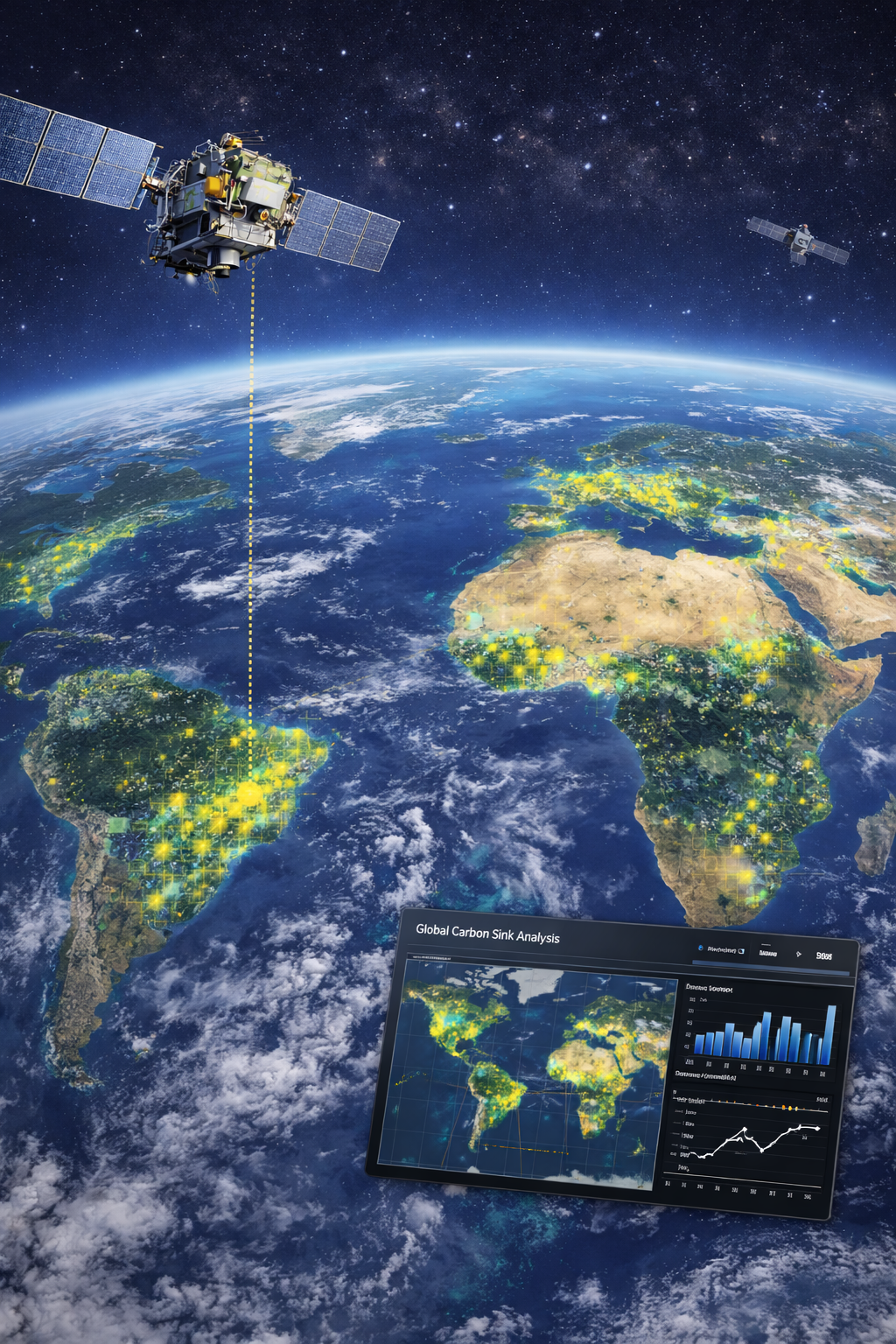
A satellite view of Earth illustrates the global distribution of carbon sinks across forests, wetlands, oceans and agricultural landscapes, highlighting the role of space-based monitoring in climate governance.
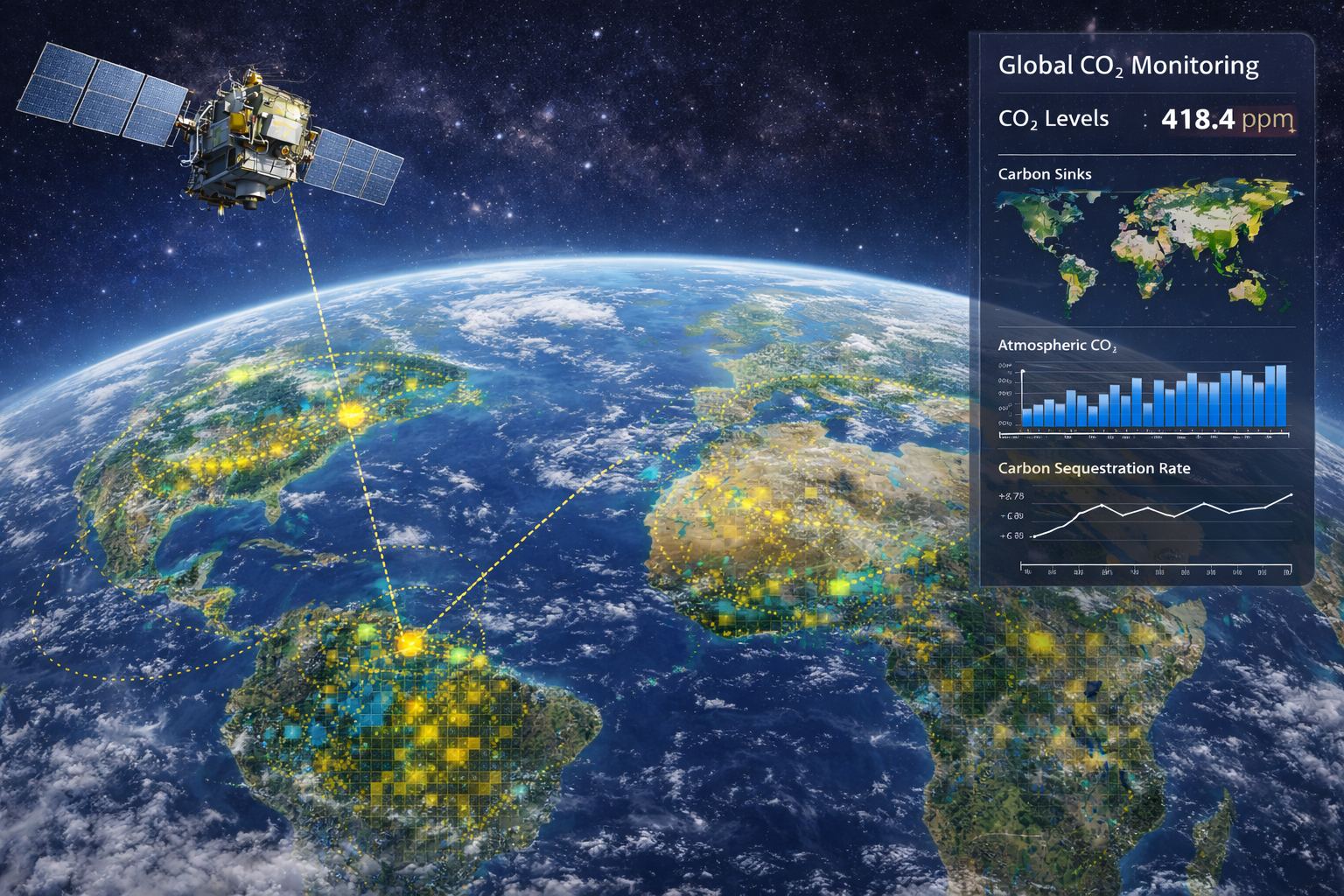
Satellites orbiting Earth monitor carbon sink applications worldwide, providing data for greenhouse gas tracking, ecosystem management, and climate governance
Using satellite data and integrated MRV systems, Taiwan advances scalable monitoring for biodiversity-based carbon projects.
TAIWAN, January 19, 2026 /EINPresswire.com/ -- As the world approaches a critical milestone in the second half of the Paris Agreement implementation period, the 2025 United Nations Climate Change Conference (COP30) is expected to focus on the integration of mitigation and adaptation strategies, Nature-based Solutions (NbS), and the substantive role of Indigenous Peoples and local communities in climate action.
Against this global backdrop, a ten-year international collaborative program formally endorsed by the International Partnership for the Satoyama Initiative (IPSI) under the United Nations University Institute for the Advanced Study of Sustainability (UNU-IAS) is being implemented with Taiwan as a key demonstration hub. The program, titled “System-of-Systems Solution in Monitoring, Reporting, Validation, and Verification on GHGs/Carbon Cycle in Biodiversity Ecosystem for SEPLS to Strengthen Sustainable Frameworks Development,” aims to deliver an integrated and internationally credible solution addressing climate change and biodiversity loss.
Centered on Socio-Ecological Production Landscapes and Seascapes (SEPLS), the project applies a System-of-Systems MRV (Monitoring, Reporting, Validation, and Verification) framework to address three issues highlighted in the COP30 agenda: Indigenous rights, ecosystem integrity, and the credibility and fairness of carbon markets. The initiative seeks to establish a long-term governance model that delivers shared benefits for Indigenous communities, ecological systems, and sustainable carbon finance.
Space technology as a bridge for climate governance
One of the key drivers behind the project’s cross-sector integration is Dr. Tsung-Sheng Cheng, Director of the Education Office at the Taiwan Space Agency (TASA). Dr. Cheng has long been engaged in space science education and interagency knowledge translation, with a focus on applying satellite and remote sensing technologies to global sustainability challenges. By integrating satellite remote sensing, ground-based sampling, carbon cycle and ecological modeling, and machine learning, the System-of-Systems framework significantly reduces the need for intensive field plots while maintaining scientific accuracy. The approach enables large-area measurement, long-term monitoring, transparent methodologies, and publicly verifiable data—features increasingly demanded by international climate governance and carbon market standards.
Prof. Shu-Mei Wang in National Taiwan University, noted that conventional carbon sink and ecosystem monitoring relies heavily on dense field sampling, often requiring one plot every 0.1 to 0.5 hectares. Such approaches are labor-intensive, costly, and poorly suited to large-scale landscapes, long-term monitoring, or cross-regional comparisons. These limitations have been a major barrier preventing many nature-based carbon projects from accessing international carbon markets or achieving high levels of verification credibility.
Linking MRV innovation with international carbon markets
The initiative is closely aligned with the Satoyama Mace Initiative, a transnational project led by Professor Yen-Hsun Su of National Cheng Kung University, which received formal endorsement from UNU-IAS and IPSI in 2024. The System-of-Systems MRV framework serves as the technical and verification backbone for this initiative.
Carbon credits generated under the Satoyama Mace Initiative have completed listing and sales agreements with the AirCarbon Exchange (ACX) in Singapore, signaling institutional acceptance by international voluntary carbon markets. The model enables biodiversity-based carbon credits to generate sustainable green finance flows that directly benefit Indigenous Peoples and local communities.
Under this framework, carbon credits are positioned not merely as corporate offset instruments, but as mechanisms supporting landscape restoration, cultural continuity, and local economic resilience—reflecting COP30’s emphasis on people-centered climate solutions.
International scientific collaboration and field validation
To ensure scientific robustness and institutional credibility, the project brings together leading researchers from Taiwan, the United States, and Canada, including Professor George C. Schatz, a member of the U.S. National Academy of Sciences. The collaboration spans physical chemistry, remote sensing, ecological modeling, and cross-scale systems analysis, aligning the project’s methodologies with international best practices.
Field implementation is currently underway through a partnership between National Cheng Kung University and the Tainan New Agriculture Cooperative, led by Dr. Cheng-Biao Yen, at a crop-based carbon sequestration innovation site. The Taiwan Space Agency’s education and imaging teams are working alongside local partners to validate the integration of satellite data and ground observations in agricultural and Satoyama landscapes.
A replicable model for global SEPLS
This site-based validation model—developed in Taiwan and designed for global replication—offers a practical pathway for SEPLS across the Asia-Pacific region and beyond. It highlights Taiwan’s emerging role at the intersection of space technology, nature-based carbon solutions, and social sustainability in the COP30 and post-COP era.
Through the combined implementation of the System-of-Systems MRV framework and the Satoyama Mace Initiative, Taiwan is sending a clear message to the international community: climate action does not have to come at the expense of biodiversity, nor should it overlook Indigenous Peoples and local communities. Advanced science and space technology, when applied inclusively, can serve as powerful tools for equity, transparency, and coexistence.
As COP30 ushers in a new phase of global climate governance, this initiative offers a pathway that is credible, verifiable, and replicable—one that bridges science, society, and sustainability.
Background
The “System-of-Systems Solution in Monitoring, Reporting, Validation, and Verification (MRV) on Greenhouse Gases and Carbon Cycles in Biodiversity Ecosystems for Socio-Ecological Production Landscapes and Seascapes (SEPLS)” is an international collaborative initiative formally recognized under the International Partnership for the Satoyama Initiative (IPSI). The activity is implemented as part of IPSI’s Collaborative Activities framework, which supports applied, multi-stakeholder cooperation among governments, academic institutions, international organizations, and local partners to advance sustainable management of SEPLS worldwide.
The initiative addresses a growing global challenge at the intersection of climate change mitigation, biodiversity conservation, and social equity: the need for scientifically credible, transparent, and scalable systems to measure and verify greenhouse gas (GHG) emissions and carbon sequestration in complex, biodiversity-rich landscapes. Many SEPLS—often managed or inhabited by Indigenous Peoples and local communities—play a critical role in maintaining ecosystem services and carbon stocks, yet face structural barriers in accessing international climate finance and carbon markets due to high monitoring costs, limited technical capacity, and difficulties in meeting stringent verification requirements.
To respond to these challenges, the project proposes a “System-of-Systems” approach to MRV, integrating multiple technological, analytical, and institutional systems into a unified framework. Rather than relying solely on dense and labor-intensive field sampling, the framework combines satellite remote sensing, ground-based observations, ecological and carbon cycle modeling, machine learning, and data governance mechanisms. This integrated architecture enables large-area coverage, long-term monitoring, methodological transparency, and reproducibility, while reducing costs and logistical burdens for project implementers and communities on the ground.
The initiative is co-led by the Taiwan Space Agency (TASA) and the SEPLS Carbon Credit Regional Revitalization Center, with strong academic and institutional participation from National Cheng Kung University, National Taiwan University, Academia Sinica, Northwestern University, the University of Toronto, and other partners. Taiwan serves as a primary demonstration hub, leveraging its advanced space technology capabilities, research infrastructure, and diverse socio-ecological landscapes to test, validate, and refine the System-of-Systems MRV framework.
A core contribution of the project lies in applying space-based technologies to climate governance in a manner that is accessible and socially inclusive. Satellite remote sensing provides consistent, repeatable observations across large spatial scales, allowing for the monitoring of vegetation dynamics, land-use change, biomass, and ecosystem productivity. When combined with targeted field measurements and advanced modeling techniques, these data streams support robust estimates of carbon stocks, fluxes, and greenhouse gas dynamics in agricultural, forested, and mosaic landscapes typical of SEPLS.
Conventional carbon sink monitoring approaches often depend on dense field plots—sometimes requiring one plot per 0.1 to 0.5 hectares—which can be prohibitively expensive and difficult to maintain over long time horizons. Such requirements have limited the participation of many biodiversity-based and community-led projects in international carbon markets, despite their ecological significance. The System-of-Systems framework addresses this gap by optimizing sampling strategies and integrating multi-source data, thereby improving efficiency without compromising scientific rigor.
Beyond technical innovation, the initiative places strong emphasis on governance, equity, and alignment with international sustainability frameworks. It is explicitly designed to support the objectives of the Kunming–Montreal Global Biodiversity Framework, particularly those related to ecosystem integrity, equitable benefit-sharing, and the recognition of Indigenous and local knowledge systems. The project also contributes to ongoing discussions under the Paris Agreement regarding the role of Nature-based Solutions, transparency frameworks, and the integrity of voluntary carbon markets.
The System-of-Systems MRV framework serves as the technical backbone of the Satoyama Mace Initiative, a transnational program endorsed by IPSI under the United Nations University Institute for the Advanced Study of Sustainability (UNU-IAS) in 2024. Under this initiative, biodiversity-based carbon credits are developed using methodologies consistent with international standards, with an emphasis on traceability, transparency, and social safeguards. Carbon credits generated through the Satoyama Mace Initiative have completed listing and sales agreements with the AirCarbon Exchange (ACX) in Singapore, reflecting growing institutional recognition of integrated, nature-based carbon solutions.
Importantly, the initiative conceptualizes carbon credits not merely as offset instruments, but as tools for supporting landscape restoration, cultural continuity, and local economic resilience. Revenue from carbon finance is intended to flow back to Indigenous Peoples and local communities, reinforcing stewardship incentives and long-term sustainability outcomes. This people-centered approach aligns with emerging global consensus that effective climate action must deliver co-benefits for biodiversity and human well-being.
Scientific robustness and credibility are ensured through international collaboration and peer engagement. The project brings together experts in physical chemistry, remote sensing, ecology, and systems analysis, including members of national academies and leading research institutions. Methodologies are designed to be transparent and auditable, enabling independent validation and supporting trust among regulators, market participants, and civil society stakeholders.
Field implementation and validation are ongoing in Taiwan through partnerships with local agricultural cooperatives and land managers. These pilot sites provide real-world contexts to test the integration of satellite observations, ground data, and modeling outputs in both agricultural and Satoyama landscapes. Lessons learned from these sites inform the refinement of methodologies and governance arrangements, with the goal of developing a model that is transferable to other regions.
As climate governance enters a new phase marked by increased scrutiny of carbon market integrity and the role of Nature-based Solutions, the System-of-Systems MRV initiative offers a practical and replicable pathway. By bridging space technology, ecological science, and inclusive governance, it demonstrates how advanced monitoring systems can support credible climate action while respecting biodiversity and the rights and livelihoods of Indigenous Peoples and local communities.
Designed for adaptation across diverse socio-ecological contexts, the framework is intended to support SEPLS throughout the Asia-Pacific region and beyond. It highlights Taiwan’s emerging role as a platform for innovation at the intersection of space technology, sustainability science, and socially grounded climate solutions, contributing to international efforts to align climate mitigation, biodiversity conservation, and equitable development.
Shu-Mei Wang
SEPLS Carbon Credit Regional Revitalization Center
email us here
Visit us on social media:
LinkedIn
Other
Legal Disclaimer:
EIN Presswire provides this news content "as is" without warranty of any kind. We do not accept any responsibility or liability for the accuracy, content, images, videos, licenses, completeness, legality, or reliability of the information contained in this article. If you have any complaints or copyright issues related to this article, kindly contact the author above.
